Skip to content
Will AI Replace Digital Marketers?
The Ultimate answer for this question

Author: Vinay Jadhav | Instructor at Epixable Academy
Updated on: October 15, 2025
Everywhere on the internet, people are asking one big question: “Will AI replace digital marketers?” Many students , freshers and even working professionals are scared because they see tools like ChatGPT and other AI apps writing content, making ads, and doing work that humans used to do. Companies also say they want to use AI to save time and money, so it can feel like there will be no jobs left for humans in marketing
But the truth is different. AI is not here to delete all marketing jobs. AI is here to change how marketing work is done and to remove some boring, repeated tasks. In this blog, you will learn what AI can do, what it cannot do, which digital marketing jobs are safe, and what skills you need to build a strong career in the age of AI
How AI Is Changing Digital Marketing Today
To understand the future, first let us look at what AI is already doing right now. The impact of AI on digital marketing is visible in almost every part of the work – content, ads, SEO, and reporting. AI is not just a “cool extra tool” anymore; it has become part of daily marketing tasks in many companies.
Using AI For Content Creation
AI is involved in almost every stage of content:
Research: AI scans many pages and gives you topic ideas, questions people ask, and gaps in existing content.
Outlines: It creates clear structures (H2, H3, bullet points) for blogs, scripts, and landing pages.
Drafts: Tools generate first drafts for blogs, ad copies, captions, e‑mails, and product descriptions
Variations: For ads and social posts, AI creates many short versions so you can test hooks and angles quickly
Using AI in ads, targeting, and budgets
In performance marketing, AI is doing a lot of “behind‑the‑scenes” work that media buyers used to do manually.
Smart bidding: Platforms like Google Ads use machine learning to set bids for each auction, based on device, time, location, audience, and hundreds of signals.
Creative testing: AI rotates different headlines, descriptions, images, and videos, then pushes more budget to the best‑performing combinations.
Audience building: It builds lookalike and intent-based audiences by studying behaviour, not just age or gender.
Budget shifting: AI detects which campaigns, ad sets, or keywords perform better and automatically moves more budget there.
Using AI in analytics, reporting and decisions
One of the most powerful (but less visible) uses of AI is in analytics and reporting.
Data analysis: AI tools scan your ad and website data and clearly show what is happening, for example, if your cost per click has increased or which audience is giving the best return on ad spend.
Detection of sudden change in Data: They alert teams when something unusual happens (sudden drop in conversions, spike in cost, tracking break) so you can react quickly.
Budget and channel optimization: AI suggests where to increase or decrease budget based on performance trends across channels.
Natural language summaries: Instead of reading 20 charts, you get plain‑language notes like “Email brought 35% of revenue this week, paid search dropped 10%.”
The Human Side: What Marketers Do While AI Does the Work
While AI is busy handling the “repetitive work” humans are not just sitting around. They are doing the “human work” that machines cannot do.
Building the Brand and Story
AI can write a sentence, but it cannot tell a story that makes people cry, laugh, or trust you. Humans spend their time deciding:
What is our brand’s unique voice?
What emotions do we want our customers to feel?
How do we stand out from competitors who are also using AI?
Managing Relationships and Ethics
Business is still about people trusting people. While AI can send 1,000 emails in a minute, it cannot build a real friendship or fix a broken relationship.
Here is what humans do to keep the business honest and trusted:
Talking to clients: AI can give you a report, but it cannot sit with a client, understand their fear of losing money, and reassure them with a solid plan.
Handling a crisis: If a brand gets hate on social media, AI might send a robotic “Sorry.” A human knows how to apologize sincerely, fix the issue, and win back trust.
- Deciding what is right: AI just follows data. It doesn’t know if an ad is offensive, misleading, or too aggressive. Humans decide which one to post without hurting the sentiments of the audience
- Protecting privacy: AI can target anyone with data, but that doesn’t mean it’s always right. You are the one who sets the limits on how customer data is used to keep it respectful and safe
In short: AI is the engine, but the human is the driver. The driver decides the destination, the speed, and the safety rules, while the engine just does the hard work of moving the car
Quality Control
AI can sometimes lie confidently (this is called “hallucination”). It might invent a statistic that looks real but is totally fake. This is dangerous for your brand’s reputation.
Fact-checking duty: Human verify every claim AI makes. If AI says “70% of people love blue cars,” human need to check if that is actually true.
Fixing the “Robot Voice”: AI loves to use fancy but empty words like “delve,” “landscape,” “realm,” and “tapestry.” Real humans don’t talk like that. So, that has to be changed to make sound more natural
Ensuring logic: Sometimes AI writes a paragraph that sounds good but makes no sense. Human are the one who reads it and says, “Wait, this doesn’t add up,” and fixes the flow.
In short: AI is the fast writer, but human are the smart editor. Human catch the mistakes before the world sees them.
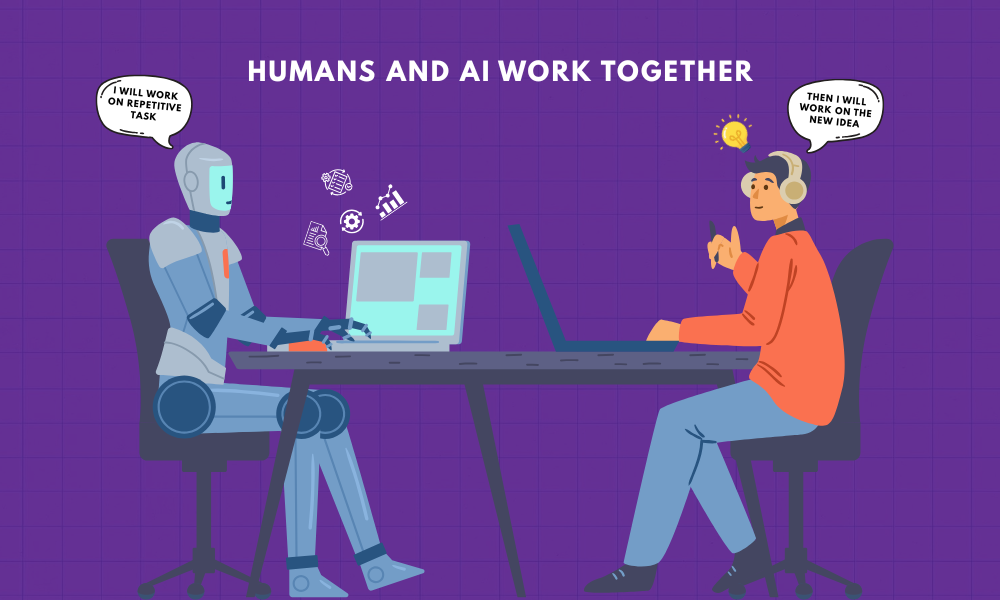
Human vs AI in Digital Marketing
Humans and AI are not enemies in digital marketing; they are two different types of brains working together. AI is like a super-fast calculator, and the human marketer is like the decision-maker who knows the brand, the market, and the culture
What AI is really good at
AI is strongest when the work is repetitive, data-heavy, or needs to scale to thousands or millions of users.
-
Handling large data: AI can quickly read ad performance, website behaviour, and basic user patterns, then highlight which campaigns are doing well or poorly.
-
Doing repeat tasks: Writing first-draft ad copies, testing many small variations of headlines or images, sending emails to large lists, and scheduling posts across platforms.
-
Following rules: If clear rules are set (for example, “If a user leaves items in the cart and doesn’t buy within 2 hours, send a reminder message”), AI can automatically send that reminder every time this happens, without any human manually checking or sending it.
AI is like a very fast junior assistant: great at doing the same type of task again and again, as long as the instructions are clear
What humans are really good at
Humans are strongest when the work needs judgment, emotion, and real-world understanding.
Understanding people: Marketers talk to real customers, listen to their fears and goals, and understand subtle things like tone, timing, and culture.
Creating original ideas: Humans can connect random things (like a local festival, a popular meme, and a product) to build a fresh campaign idea that AI would not imagine in that way.
Taking responsibility: When something goes wrong—an ad offends people or a message is misunderstood—humans decide how to respond, apologize, and rebuild trust.
Humans act like the “brains and heart” of the marketing function, deciding what the brand should say and how it should behave in front of real people
How they work together
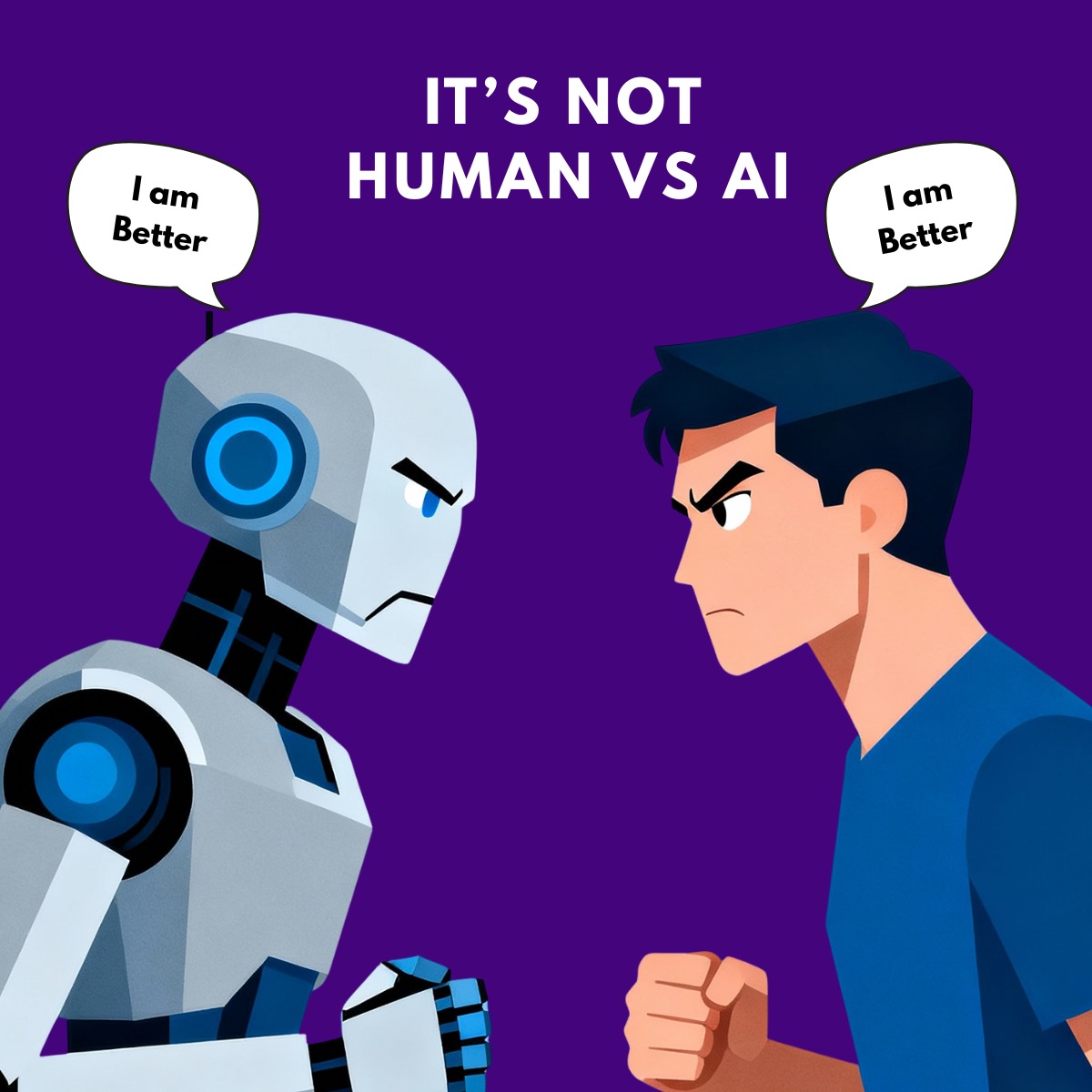
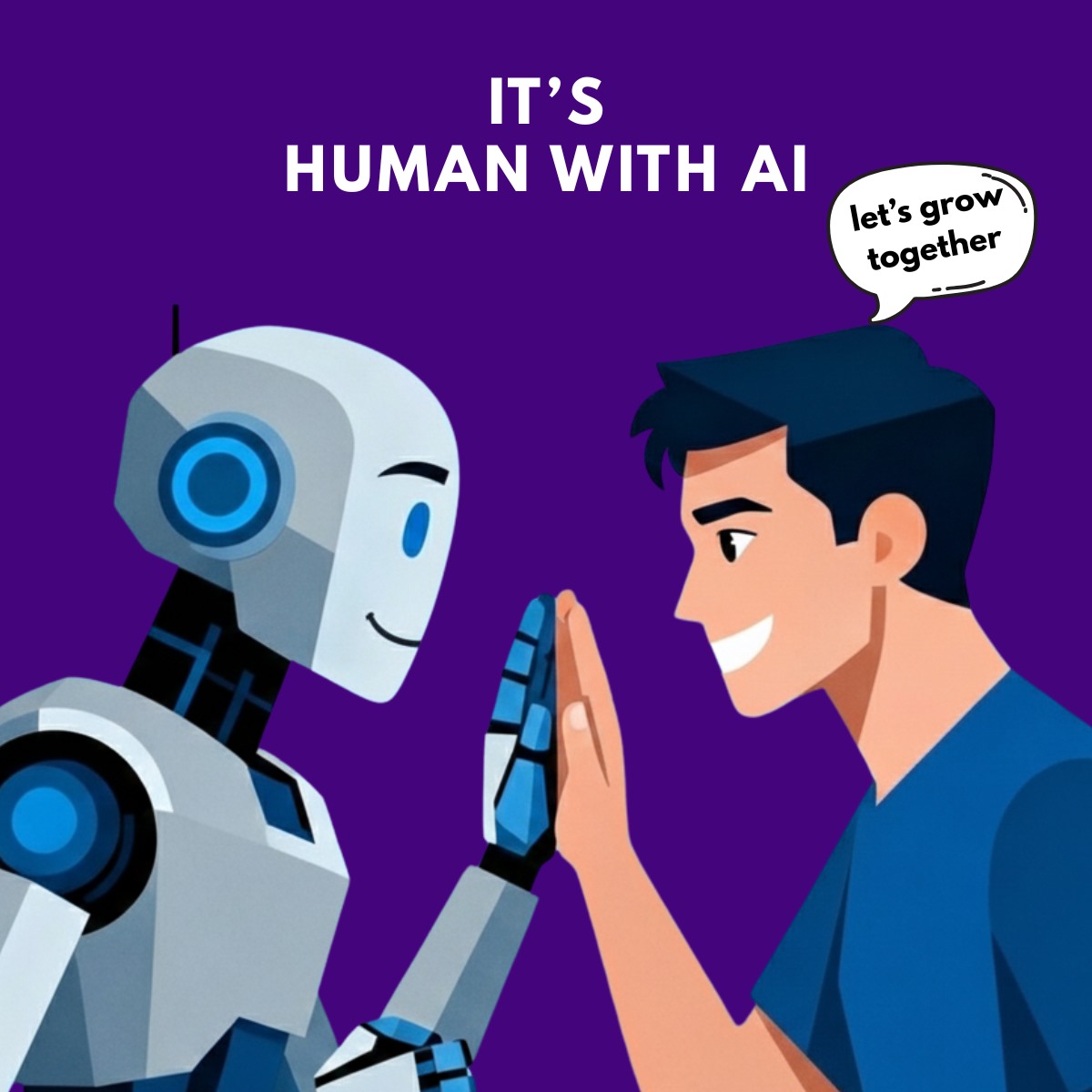
In modern digital marketing teams, the most powerful setup is not “Human VS AI” but “Human with AI”
AI can suggest ideas, but the human selects, edits, and shapes them to match the brand and audience.
AI can report numbers, but the human decides what those numbers mean for the next step in the campaign.
AI can automate operations, but the human decides the overall strategy, positioning, and ethical limits.
So the balance is clear: AI provides speed and scale, humans provide direction and sense. Marketers who learn to combine both will stay valuable and in demand in the AI era.
What is the Future of Digital Marketing?
The future of digital marketing is moving from “run campaigns on platforms” to “design systems that learn, adapt, and talk to each user differently.” It is less about knowing buttons on Meta/Google and more about knowing how data, AI models, and human psychology work together
From “showing ads” to predicting behaviour
Instead of just showing ads based on past behaviour, marketing will predict what a person is likely to do next and act before that moment.
Predictive models will score who is most likely to buy, churn, upgrade, or respond to a discount, and then trigger the right message or offer in real time.
This shifts marketing from “reactive” (after the click) to “proactive” (before the decision), making every rupee of ad spend work harder.
Roles shift from operators to orchestrators
Most entry‑level “button‑clicking” will be gone because of AI. New roles will look like:
Marketing systems strategist: Designs end‑to‑end funnels, automation, and data flows, decides where AI should sit and what it should optimise for.
Creative performance lead: Sits between copy/design and media, uses data to brief creatives and uses AI to scale variations.
Strong careers will come from combining one deep craft (e.g., performance, content, CX) with AI, data, and experimentation literacy.
Future of content and research
Content research will lean on AI to scan the web, find topic gaps, analyse competitors, and suggest outlines, FAQs, and examples in seconds.
The real value will come from adding local insights, real stories, data, and a clear brand voice on top of AI drafts, so content feels human and trustworthy, not generic.
If you want, each of these four can be expanded into a separate sub‑section in the blog with 2–3 short paragraphs and examples for Indian brands and students.
Core digital marketing skills (still non‑negotiable)
- SEO, SEM, and ads strategy: understanding search intent, funnels, offers, landing pages, and how to make campaigns profitable, not just “run ads.”
- Content and storytelling: planning content, writing clearly, and explaining products in a simple, convincing way across blogs, videos, emails, and social posts.
- Analytics basics: reading dashboards, understanding metrics like CPC, CPA, ROAS, retention, and using them to improve campaigns

AI and data skills
AI literacy: knowing what AI tools can and cannot do, how they work in marketing platforms, and where human review is still needed.
Prompting and workflows: writing clear prompts, giving context, and building repeatable workflows (for research, drafts, ad ideas, reports) instead of using AI randomly.
Data literacy: asking the right questions of data, understanding segments, experiments, and using AI insights to make decisions, not just to generate pretty charts
Soft skills that matter more now
- Critical thinking: checking AI outputs for accuracy, bias, and logic instead of trusting everything it produces.
- Creativity and curiosity: using AI to explore many ideas, then choosing bold, human, culture‑aware concepts that actually stand out.
- Communication and collaboration: working across teams (sales, product, tech, creatives) and explaining AI‑driven ideas in simple language to clients and managers.
Now the real question is "Will AI replace digital marketers?"
AI will not take away all digital marketing jobs, but it will take away the easy, repetitive ones and expose people who only do “button‑clicking” work. Marketers who know strategy, creativity, clients, and also know how to use AI will not be replaced – they will be the ones who grow fastest in this new system